Microglial Mechanisms Underlying VCID After Brain Injury
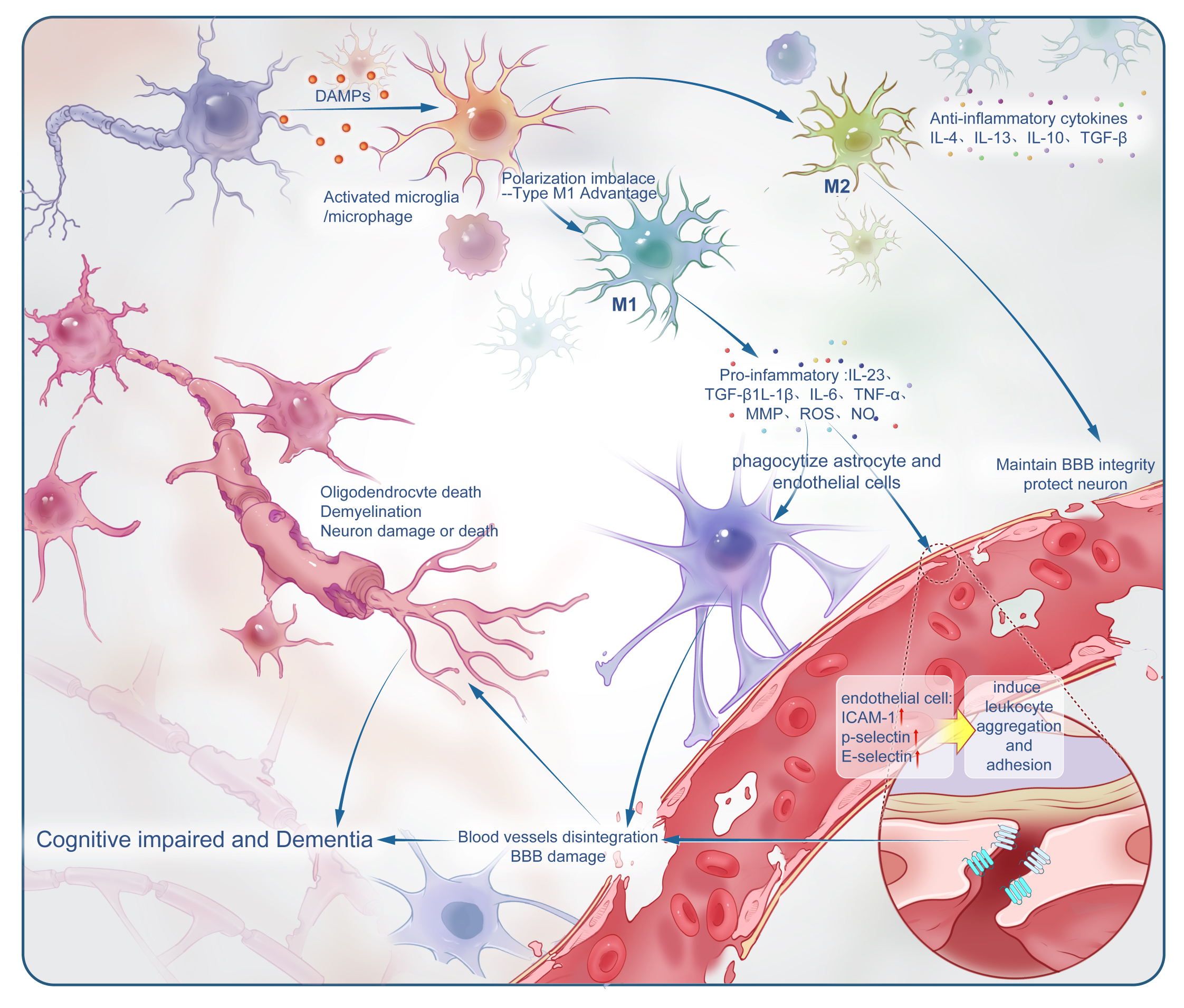
Following brain injury, damaged neurons release DAMPs,
which activate resident microglia. These microglia respond to the local
microenvironment by polarizing into either a pro-inflammatory (M1) or
anti-inflammatory (M2) phenotype. M2 microglia exerts anti-inflammatory and
reparative effects by secreting cytokines such as IL-4, IL-10, IL-13, and
TGF-β. In contrast, M1 microglia exhibits a pro-inflammatory profile, releasing
cytokines including IL-1β, IL-6, TNF-α, and IL-23, as well as reactive oxygen
species (ROS), nitric oxide (NO), and matrix metalloproteinases (MMPs). These
mediators contribute to the disruption of the blood-brain barrier (BBB) by
damaging endothelial cells and promoting the expression of adhesion molecules
such as ICAM-1, P-selectin, and E-selectin on the endothelial surface. This
facilitates leukocyte adhesion and transmigration, initiating a cascade of
neuroinflammatory responses. Moreover, these pro-inflammatory cytokines
interfere with phospholipid metabolism, leading to the production of
arachidonic acid and ceramide, which further amplify inflammation and neuronal
injury. M1 microglia may also phagocytose endothelial cells and astrocytes,
exacerbating BBB breakdown. In addition, they can engulf myelin and axons and
inhibit the maturation of oligodendrocytes, thereby impairing remyelination.
These processes collectively result in white matter degeneration,
oligodendrocyte death, and axonal damage, ultimately leading to neuronal loss
and the clinical manifestation of cognitive impairment and dementia. This
illustration spatially emphasizes these interactions—from the initial neuronal
injury and DAMP release to microglial activation and polarization, endothelial
damage and BBB breakdown, and finally, to white matter demyelination—all converging
toward the development of vascular cognitive impairment and dementia (VCID).