|
|
|
CD36 Signaling in Diabetic Cardiomyopathy
Aging and disease
2021, 12 (3):
826-840.
DOI: 10.14336/AD.2020.1217
Cluster of differentiation 36 (CD36), also referred to as scavenger receptor B2, has been shown to serve multiple functions in lipid metabolism, inflammatory signaling, oxidative stress, and energy reprogramming. As a scavenger receptor, CD36 interacts with various ligands, such as oxidized low-density lipoprotein (oxLDL), thrombospondin 1 (TSP-1), and fatty acid (FA), thereby activating specific downstream signaling pathways. Cardiac CD36 is mostly expressed on the surface of cardiomyocytes and endothelial cells. The pathophysiological process of diabetic cardiomyopathy (DCM) encompasses diverse metabolic abnormalities, such as enhanced transfer of cardiac myocyte sarcolemmal FA, increased levels of advanced glycation end-products, elevation in oxidative stress, impaired insulin signaling cascade, disturbance in calcium handling, and microvascular rarefaction which are closely related to CD36 signaling. This review presents a summary of the CD36 signaling pathway that acts mainly as a long-chain FA transporter in cardiac myocytes and functions as a receptor to bind to numerous ligands in endothelial cells. Finally, we summarize the recent basic research and clinical findings regarding CD36 signaling in DCM, suggesting a promising strategy to treat this condition. 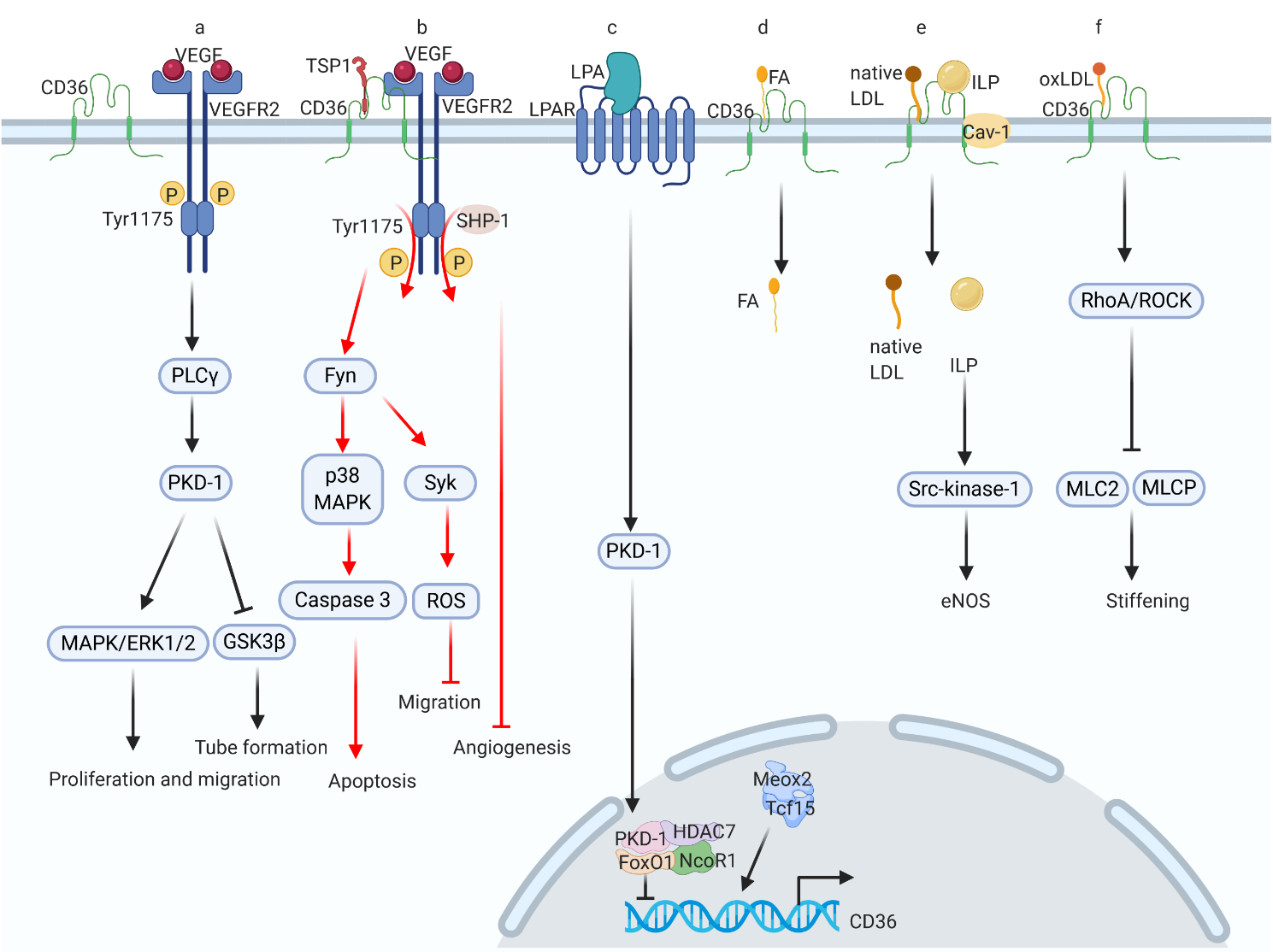
Figure 3. CD36 signaling pathways in endothelial cells. There are approximately seven signaling events related to CD36 in endothelial cells. (a) VEGF binds to its receptor to promote vascular migration and angiogenesis; (b) TSP-1 targets CD36 and CD36 forms a complex with VEGFR to inhibit VEGF signaling, thus promoting apoptosis and suppressing cell migration; (c) LPA can interact with its receptor and trigger downstream signaling to inhibit CD36 transcription; (d) CD36 transfers FA; (e) CD36 forms a complex with Cav-1 to mediate endocytosis of native LDL and intralipid to produce eNOS; (f) CD36 binds to oxLDL and mediates oxLDL-induced endothelial stiffening. VEGF, vascular endothelial growth factor; VEGFR2, vascular endothelial growth factor receptor 2; Tyr, tyrosine; PLC γ, phospholipase C γ, PKD-1, protein kinase D-1; MAPK, mitogen-activated protein kinase; ERK1/2, extracellular regulated protein kinase 1/2; GSK-3β, glycogen synthase kinase-3 beta; TSP-1, thrombospondin-1; SHP-1, srchomology 2 domain containing protein tyrosine phosphatase-1; Fyn, Src family kinase Fyn; Syk, tyrosine-protein kinase Syk; LPA, lysophosphatidic acid; GPCR, G-protein coupled receptor; LPAR, LPA receptor; HDAC7, histone deacetylase 7; FoxO1, forkhead box protein O1; NCoR1, nuclear receptor corepressor 1; Meox2, homeobox protein MOX-2; Tcf15, transcription factor 15; Cav-1, caveolin-1; eNOS, endothelial nitric oxide synthase; RhoA/ROCK, RhoA /Rho kinase; MLCP, myosin light-chain phosphatase; MLC2, myosin light-chain 2.
Other Images/Table from this Article
|